Post Falls vs. Coeur d’Alene: Which Area Fits Your Lifestyle?
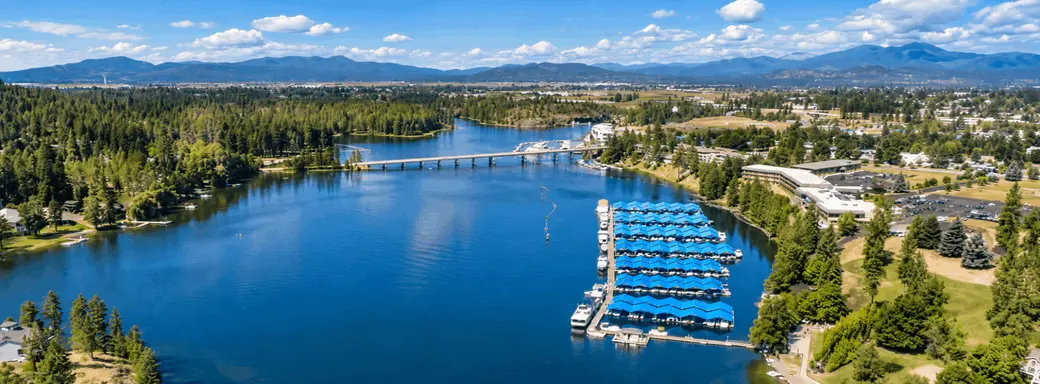
If you're moving to North Idaho, there's a pretty good chance you'll end up comparing Post Falls vs. Coeur d’Alene at some point.
They're close enough that you can easily live in one and spend plenty of time in the other.
But living in Post Falls and living in Coeur d’Alene can feel very different.
One puts you closer to the Washington border and Spokane. The other puts you right in the middle of the lake, downtown and recreation lifestyle that most people picture when they think about Coeur d’Alene.
So which one makes more sense?
I'd actually start with a different question:
What do you want your everyday life to look like?
Because that's usually what separates these two areas more than a line on a map.
First: How Close Are Post Falls and Coeur d’Alene?
Post Falls sits directly west of Coeur d’Alene along I-90.
That means choosing Post Falls doesn't mean giving up Coeur d’Alene.
You can live in Post Falls and still head into Coeur d’Alene for dinner, spend a summer day on Lake Coeur d’Alene or meet friends downtown.
Likewise, living in Coeur d’Alene doesn't put Spokane out of reach.
The bigger question is which direction you'll travel most often.
If Spokane and Spokane Valley are going to be a regular part of your life, Post Falls deserves serious consideration.
If most of your life will revolve around Coeur d’Alene, Hayden and the lake, living farther east may make more sense.
The Overall Feel: Post Falls vs. Coeur d’Alene
This is probably the biggest difference I notice.
Coeur d’Alene feels more like the center of the North Idaho lifestyle.
You have downtown, Lake Coeur d’Alene, restaurants, parks, beaches, trails and events concentrated in a relatively small area.
There are also dramatically different housing options depending on where you go—from downtown condos and older established neighborhoods to newer communities, luxury properties and waterfront homes.
Post Falls feels more residential and spread out.
There's been a lot of residential growth, and you'll find newer subdivisions, established neighborhoods, riverfront properties and larger parcels as you move toward the outskirts.
Post Falls also sits along the Spokane River, which gives the city its own waterfront identity that I think sometimes gets overlooked when people are relocating here.
Neither feel is necessarily better.
They're just different.
If You Want Downtown and Walkability
Coeur d’Alene has the advantage if your vision of North Idaho includes walking to coffee, restaurants, parks and the lake.
Downtown Coeur d’Alene centers around Sherman Avenue and the lakefront.
McEuen Park sits along the waterfront with a playground, splash pad, dog park, sports courts, boat launch and direct access to Tubbs Hill.
Tubbs Hill itself is a 165-acre natural area surrounded on three sides by Lake Coeur d’Alene, with several miles of trails—including a roughly 2.2-mile trail around the perimeter.
That's a pretty unusual amenity to have immediately adjacent to downtown.
So if your ideal Saturday morning involves grabbing coffee, walking downtown and heading onto a trail overlooking the lake without getting into your car again, Coeur d’Alene is probably going to catch your attention.
But Don't Overlook Outdoor Life in Post Falls
Post Falls doesn't have Lake Coeur d’Alene sitting beside downtown.
It does, however, have the Spokane River.
And there is much more outdoor recreation in Post Falls than relocating buyers sometimes realize.
Q'emiln Park sits along the Spokane River and includes a swimming beach, boat launch, picnic areas, playground, scenic views and access to the Post Falls Community Forest and climbing areas.
The city's park system includes dozens of parks and miles of trails.
So this isn't really a choice between "outdoors" and "no outdoors."
It's more about what kind of access you want.
Coeur d’Alene: lake + downtown + trails.
Post Falls: river + parks + trails + easier westward access.
Spokane Commuters Should Look Closely at Post Falls
If you work in Spokane or Spokane Valley, this may be one of the most important sections of this entire article.
Post Falls is west of Coeur d’Alene, which puts you closer to Washington.
That doesn't mean everyone who works in Spokane should automatically live in Post Falls.
But that extra distance between Post Falls and Coeur d’Alene matters when you're driving it twice a day, five days a week.
And your actual destination matters too.
Commuting to Spokane Valley is different from commuting all the way into downtown Spokane.
If you're considering living in Idaho and working in Washington, I recommend driving the commute during the time you'd actually be making it.
Not at noon.
Not on Sunday.
Drive it when you'd be going to work.
Then decide whether you're comfortable doing it regularly.
What Does Your Housing Budget Buy?
This is where I don't like giving people a blanket answer such as:
"Post Falls is cheaper."
Housing markets move, and the answer depends heavily on what you're trying to buy.
Instead, I prefer comparing actual homes within your budget.
Let's say you're shopping around $700,000.
Rather than asking which city has the lower median price, I'd pull properties around $650,000–$750,000 in both areas and look at what you actually get.
Square footage.
Lot size.
Age.
Garage.
Updates.
Neighborhood.
Commute.
New construction.
Proximity to the water.
That's much more useful than comparing two citywide averages.
New Construction
If new construction is high on your list, I'd absolutely include Post Falls in your search.
Post Falls has experienced substantial residential development, which means buyers can find newer neighborhoods and new-construction opportunities throughout the area.
But don't stop your search at the city boundary.
Depending on your budget and what you're looking for, I'd probably also have you looking at Rathdrum and parts of Hayden.
And if you're considering building a custom home rather than buying in a subdivision, that opens an entirely different conversation.
What If You Want Acreage?
This is where I'd probably widen your search beyond both cities.
You can find larger properties around Post Falls and Coeur d’Alene, particularly as you move toward their outskirts.
But if someone tells me:
"Amanda, I want five acres, a shop, trees and some privacy."
I'm probably not limiting their search to Post Falls and Coeur d’Alene.
I'm also looking at Rathdrum, Athol, Hayden-area properties, Spirit Lake and potentially farther north, depending on their commute and budget.
Acreage searches are also where I care much more about the individual property than the town printed on the mailing address.
Five beautiful, usable acres with good access can be a completely different property from five steep or heavily constrained acres.
If acreage is your goal, read my Buying Acreage in North Idaho: 12 Things to Know Before You Buy guide before you start shopping.
Lake Coeur d’Alene vs. Spokane River
This may be one of the easiest lifestyle distinctions between the two cities.
If your dream specifically revolves around Lake Coeur d’Alene, living in Coeur d’Alene obviously puts you closer to it.
Boating, beaches, paddleboarding and lake days are a huge part of summer here.
Post Falls has a different relationship with the water.
The Spokane River runs through the community, and areas such as Q'emiln Park give residents access to swimming, boating and waterfront recreation.
If you're a serious boater, I'd think beyond simply asking which city has water.
Where will you keep the boat?
Which launch will you use?
Do you want to be on Lake Coeur d’Alene specifically?
Would river access satisfy what you're looking for?
Do you want waterfront property?
Those answers can change where I'd have you look.
Restaurants, Shopping and Everyday Convenience
Both cities provide access to everyday shopping, groceries and services, and because they're so close together, you'll probably use businesses in both regardless of which one you call home.
Coeur d’Alene has the more established destination downtown, particularly around Sherman Avenue.
If being able to walk to restaurants, coffee, shops, parks and the lake is high on your priority list, that's difficult for Post Falls to replicate in exactly the same way.
Post Falls, however, can be extremely convenient for someone whose life stretches west toward Spokane while still wanting easy access to Coeur d’Alene.
This is another category where I'd think less about city boundaries and more about where your specific house sits.
What About Families?
I wouldn't choose between Post Falls and Coeur d’Alene based on a generic internet ranking.
If schools are important to your move, research the specific school serving the specific property you're considering.
School boundaries matter.
Programs matter.
Your child's needs matter.
And those are much more useful considerations than someone online declaring an entire city "better for families."
I'd also look at the everyday things that affect your household:
Where are your activities?
How long is the school commute?
Where will you grocery shop?
Where do you work?
Where will you spend your weekends?
Sometimes the answer becomes pretty obvious once you put your actual weekly routine on a map.
What About Winter?
Winter is another reason location within each city matters.
If you're staying within established neighborhoods, your experience can be very different from someone living on acreage outside town with a long private driveway.
If you're looking farther outside either Post Falls or Coeur d’Alene, start asking about:
Road maintenance.
Snow removal.
Driveway slope.
Private roads.
Shade and ice.
Your commute.
You might love that winding driveway through the trees in August.
I want you to picture it in January too.
Post Falls Might Make Sense If...
You want convenient access toward Spokane and Spokane Valley.
You like newer residential development.
You want access to the Spokane River.
You're comfortable driving into Coeur d’Alene for downtown activities and lake days.
You're trying to balance North Idaho living with a job or commitments in Washington.
Or you simply find the house and neighborhood you love there.
Coeur d’Alene Might Make Sense If...
Being near Lake Coeur d’Alene is a major reason you're moving.
You want access to downtown restaurants, shops, parks and events.
You value having trails and recreation integrated into the city.
You want the lifestyle associated with downtown Coeur d’Alene.
You don't need to commute west toward Spokane as frequently.
Or—again—you simply find the house and neighborhood that fit you better.
And You Might End Up Choosing Neither
This happens more often than people expect.
Someone contacts me convinced they want Coeur d’Alene.
Then we start talking.
They want five acres.
A 40×60 shop.
No HOA.
Trees.
Room for an RV.
And they work from home.
Okay.
Now we're having a completely different conversation.
Maybe we should be looking at Rathdrum.
Maybe Athol.
Maybe Hayden.
Maybe somewhere farther north.
On the other hand, someone might initially tell me they want acreage and then realize they actually want to be ten minutes from restaurants and don't want to spend their weekends maintaining five acres.
That's why I don't start relocation searches by asking:
"Which city do you want?"
I start with:
"How do you want to live?"
So, Post Falls or Coeur d’Alene?
If access to Spokane is a major priority, Post Falls deserves a serious look.
If downtown, Lake Coeur d’Alene and having recreation immediately around you are major priorities, Coeur d’Alene deserves a serious look.
But neither city is one single type of neighborhood or property.
And because they're so close together, you don't necessarily need to decide before you start looking.
In fact, I wouldn't.
I'd tour both.
Drive the commute.
Spend some time downtown.
Visit the parks.
Look at homes in your actual price range.
And then compare what your money—and your lifestyle—look like in each.
Moving to North Idaho?
If you're considering Post Falls, Coeur d’Alene or one of the surrounding North Idaho communities, start with my Complete Guide to Moving to Coeur d’Alene, Idaho.
If you're moving across the state line, read Washington vs. Idaho: Cost of Living Near the State Line.
And if you're dreaming about land, a shop or a little more distance between you and your neighbors, read Buying Acreage in North Idaho: 12 Things to Know Before You Buy.
Or download my North Idaho Relocation Guide and start comparing communities based on what actually matters to you.
Because the goal isn't finding the "best" city in North Idaho.
It's finding the one that feels like home.
Helping you find more than home.
Categories
Recent Posts